 Twice A DayJournal
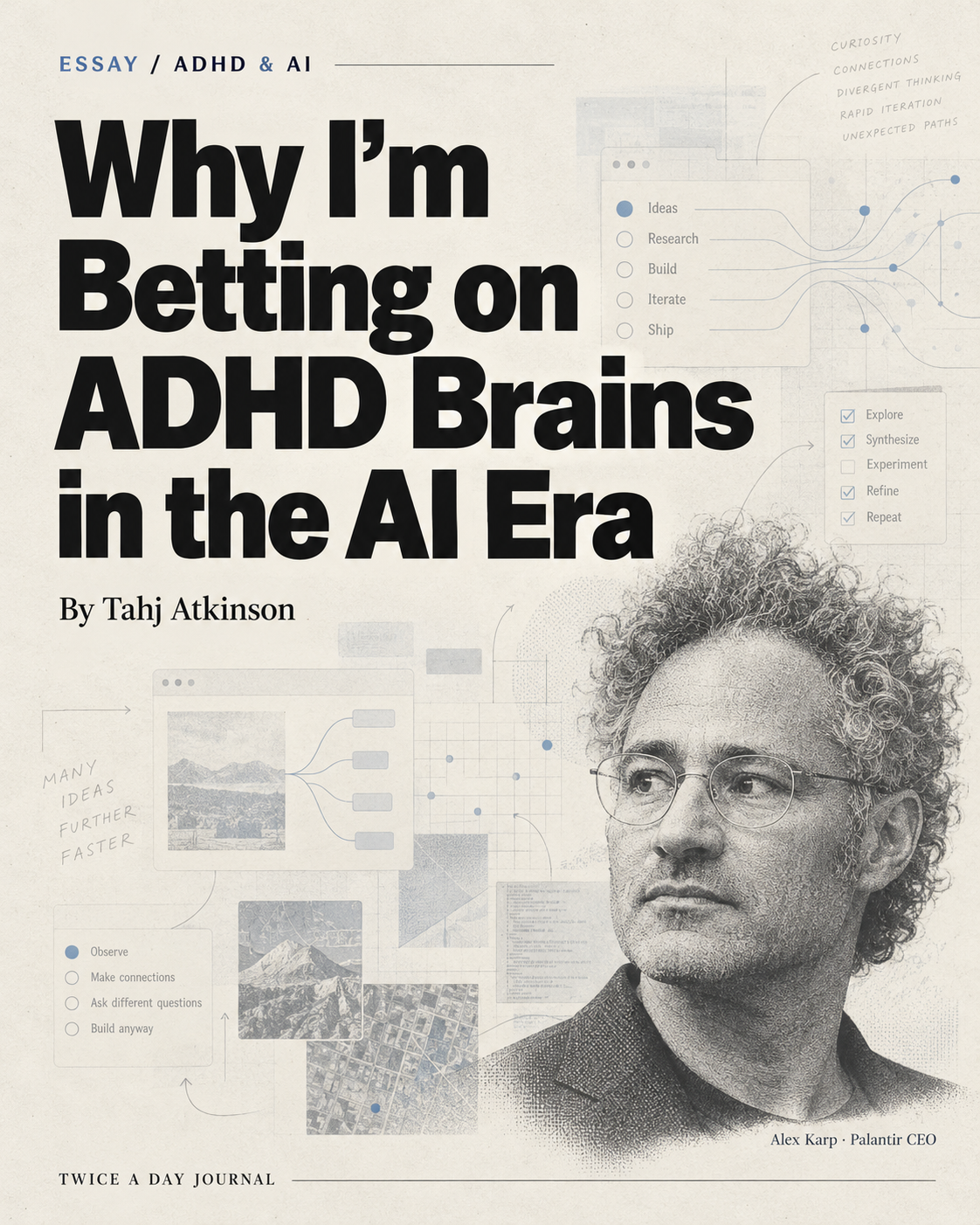
Having more ideas than you know what to do with gets old when you never get to do anything with them.
You see something that could be better. You think of a business. You connect two things that nobody around you seems interested in connecting. Then you look at everything you would have to learn, organize and finish to make it real, and it becomes another note in your phone.
I have ADHD. I’ve never been short on ideas. Following through has been the expensive part.
That’s why I’m optimistic about AI. It can shorten the distance between an interesting thought and something you can actually test. For people whose ideas have consistently outrun their ability to execute, that matters.
Karp is making a bet on different thinkers
Palantir CEO Alex Karp put it bluntly: “the neurally divergent (like myself) will disproportionately shape America’s future.” His remarks accompanied the company’s Neurodivergent Fellowship announcement, as reported by Tom’s Guide.
The fellowship listing explicitly points to pattern recognition, nonlinear thinking and hyperfocus as qualities the company believes will matter in an AI-driven world.
He’s talking about neurodivergence broadly. I’m interested in what that could mean for people with ADHD.
My bet is that some of the traits we’ve struggled to make useful will become easier to put to work when the tools can handle more of the steps between thinking and doing.
Your range of interests can become useful
Imagine you’re interested in fitness, software, psychology and making videos. For years, those might have looked like four distractions competing for your attention.
Now imagine you spot a problem at the intersection of them. You understand why people abandon workout routines. You have an idea for a tool. You know how you would explain it to someone.
AI can help you explore the software, put together a rough prototype and draft the explanation. You still have to judge whether any of it is good, check that it works and put it in front of people.
But you can start testing the connection without first becoming an expert in every discipline involved.
This is where I think having varied interests gets interesting. Something you learned during one obsession can become useful in another. The tools give you a more practical way to find out.
Curiosity has somewhere to go
An unusual question becomes more valuable when you can investigate it.
What if the onboarding worked differently? Why does everyone in this industry accept that annoying step? Could something from a completely different field solve this problem?
There is research behind parts of this conversation. In a study of creativity in adults with ADHD, participants with ADHD reported more real-world creative achievements and produced more original ideas under a particular reward condition. That doesn’t make creativity a guaranteed feature of a diagnosis. It does give us a reason to take these strengths seriously.
If generating possibilities is something you’re good at, AI gives you a way to examine more of them. Ask for a rough implementation. Find the weak assumption. Try a version. See whether the idea survives contact with reality.
The question that used to end with “I wouldn’t know where to start” can now lead somewhere.
Put the deep dive to work
Hyperfocus is another part of ADHD that deserves more than a motivational slogan. Research by Hupfeld and colleagues found that adults with higher ADHD symptom levels reported more frequent hyperfocus across several settings.
If you recognize that experience, you know how absorbed you can become in something that catches your interest. The useful opportunity is to give that interest a result to work toward.
Instead of spending the whole evening reading about an idea, use the tools to make a version of it. Ask questions as you encounter problems. Check the answers. Keep improving the same thing.
Choose what you want to have at the end, and set a stopping point. A deep dive is more useful when you come back with something besides twenty new tabs.
Wearing several hats doesn’t mean doing everything at once
I expect more work to involve moving between defining a problem, directing tools, reviewing results and deciding what happens next. That creates room for people who enjoy understanding how different parts fit together.
It also needs structure. Being pulled toward several things isn’t the same as handling them all well.
Use AI to hold the context: what you decided, what you tried, what remains unresolved. Ask it to organize your rough notes and suggest the next concrete step. Check that summary before relying on it.
You can wear several hats without making yourself remember every detail under each one.
Give yourself a chance to find out
I’m not interested in being told my ADHD is a superpower while the same unfinished projects sit there.
I’m interested in having tools that let me do more with the parts of my thinking I actually like. The curiosity. The ideas. The willingness to get very interested in something other people consider a strange use of an afternoon.
If you’ve spent years measuring yourself by how well you tolerate a way of working that doesn’t suit you, try a different test. Pick one idea you keep returning to. Use AI to get a small version in front of someone. Finish enough to learn whether it works.
You don’t have to become a different person before you’re allowed to build something worthwhile.